Case Studies

ये conceptual showcases नहीं हैं। ये homes, villas, apartments, solar installations, private networks, automation layers और local-first infrastructure में built real systems हैं।

Case Studies के लिए visual system image
Domestic solar power system with hybrid inverter, battery storage, meters, and rooftop panels

Case Studies

Solar और Energy Systems

Hybrid Solar Power System for a Residential Home

यह case study Hybrid Solar Power System for a Residential Home को real implementation की तरह explain करती है: design choices, integration, reliability, monitoring और operating lessons के साथ।

इस implementation में This project involved designing and installing a hybrid solar setup for a residential property where backup reliability, grid reduction, and everyday usability mattered equally.

इस implementation में The architecture was built around a 10kW solar panel array, paired with a 20kW hybrid inverter and a 20kWh LiFePO4 battery bank to support meaningful household loads during outages.

इस implementation में A key design principle was resilience. The system needed to support normal household behavior, maintain power during grid interruptions, and create a foundation for future energy monitoring and automation.

इस implementation में The installation required careful planning around panel placement, inverter capacity, battery sizing, cable routing, load priority, safety, and operational visibility.

  • 10kW solar panel installation
  • 20kW hybrid inverter integration
  • 20kWh LiFePO4 battery bank
  • Grid + solar + battery operating model
  • Load resilience during power outages
  • Foundation for energy monitoring और automation

High-Capacity Residential Solar Backup System

यह case study High-Capacity Residential Solar Backup System को real implementation की तरह explain करती है: design choices, integration, reliability, monitoring और operating lessons के साथ।

इस implementation में This implementation was a higher-capacity residential energy project designed for a home with larger load expectations and stronger backup requirements. The system used 20kW solar panels, a 30kW hybrid inverter, and a 30kWh LiFePO4 battery bank.

इस implementation में The system design focused on capacity, safety, and operational headroom. A 30kW hybrid inverter was selected to handle higher load peaks, support larger solar input, and manage battery-backed power with better flexibility. The 30kWh battery bank provided extended backup duration and improved the ability to absorb solar generation during the day for later use.

इस implementation में The installation required a more deliberate approach to load estimation, inverter sizing, DC/AC protection, cable capacity, battery placement, thermal considerations, and system maintainability. The larger the system, the more important the control architecture becomes. This was not simply about increasing hardware capacity - it was about ensuring that generation, storage, conversion, and consumption worked together predictably.

इस implementation में The final system created a robust residential power platform capable of supporting high-energy usage patterns while reducing grid dependence and improving continuity.

  • 20kW solar panel array
  • 30kW hybrid inverter
  • 30kWh LiFePO4 battery bank
  • High-load residential backup
  • Improved energy autonomy
  • Scalable architecture for monitoring और automation

Distributed 5kW Residential Solar Installations

यह case study Distributed 5kW Residential Solar Installations को real implementation की तरह explain करती है: design choices, integration, reliability, monitoring और operating lessons के साथ।

इस implementation में In addition to hybrid battery-backed systems, I also implemented smaller 5kW online solar systems for two residential users in my locality. These systems were designed for simpler grid-connected solar generation where the primary goal was to reduce electricity bills and improve daytime solar utilization.

इस implementation में Unlike battery-backed hybrid systems, online solar systems focus on grid-connected generation. The design emphasis was on panel placement, inverter compatibility, electrical safety, generation efficiency, and user awareness. These installations required practical decision-making around roof space, shadowing, wiring paths, protection devices, and integration with the existing electrical setup.

इस implementation में The value of these projects was not just technical installation. It involved helping homeowners understand solar feasibility, expected generation, system behavior, and operational limitations. This made the installations more sustainable from a user-adoption perspective.

  • 5kW grid-connected solar systems
  • Residential rooftop planning
  • Online inverter setup
  • Existing electrical integration
  • Practical solar adoption for local homes
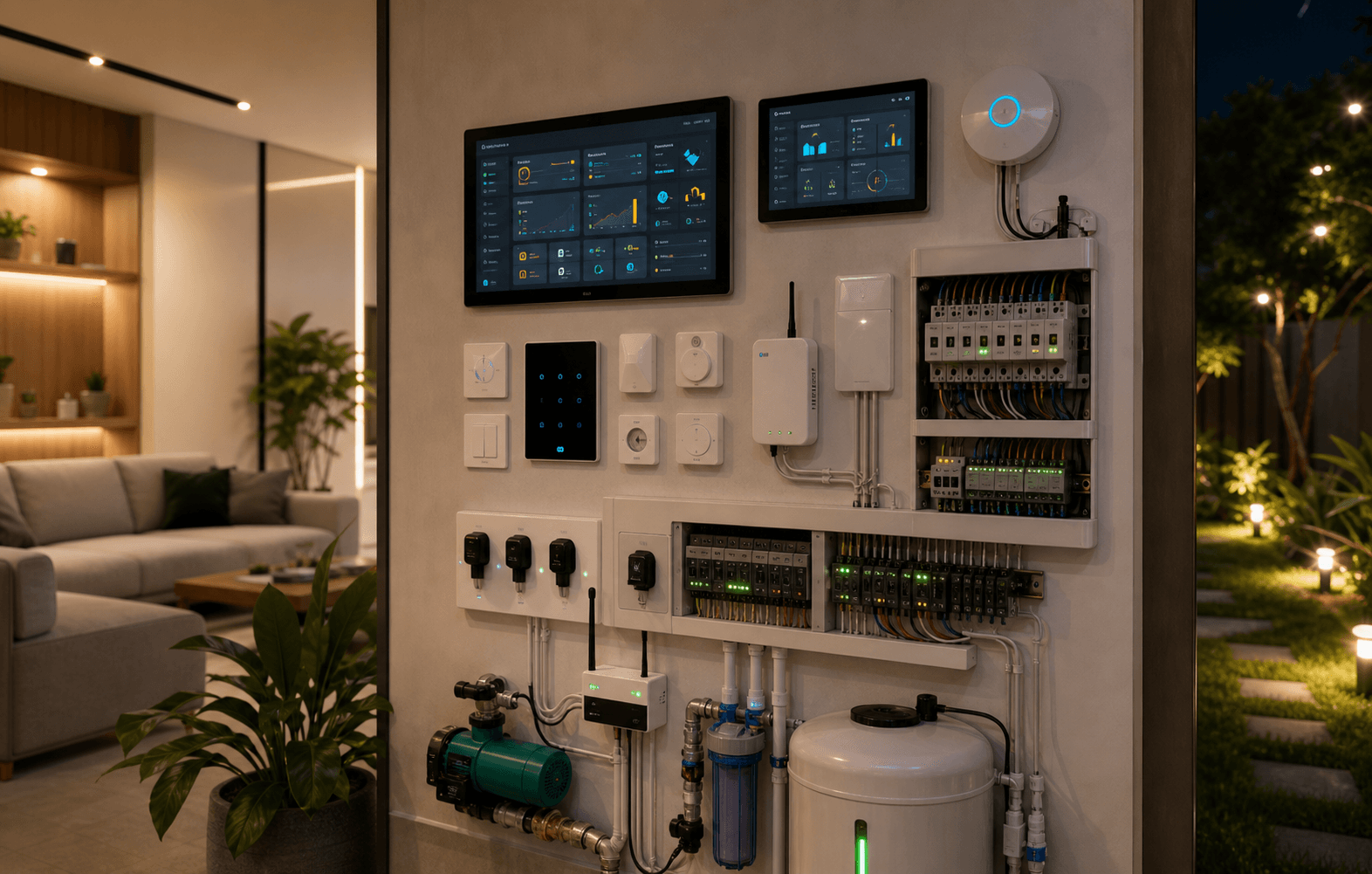
Smart living automation cabinet with controllers, sensors, water systems, and dashboard

Case Studies

Smart Living और Home Automation

End-to-End Automation for a Four-Story Residential Building

यह case study End-to-End Automation for a Four-Story Residential Building को real implementation की तरह explain करती है: design choices, integration, reliability, monitoring और operating lessons के साथ।

इस implementation में This project was a full-stack smart building implementation for a newly constructed four-story residential property. Because the building was new, the automation architecture could be planned from the wiring stage instead of being forced into the limitations of an existing electrical layout.

इस implementation में The implementation covered smart-system wiring, power monitoring, power-saving strategies, smart lighting, smart climate control, lift integration, motorized gates, pump control, water tank automation, smart locks, camera systems, and irrigation control. The goal was to create a residential environment that could respond intelligently to occupancy, usage patterns, safety events, and operational needs.

इस implementation में A major architectural choice was to keep the automation control plane private. Instead of relying fully on cloud-first consumer automation platforms, the setup used an in-house homelab running Home Assistant. This allowed automation data, device state, control logic, and historical telemetry to remain local wherever possible.

इस implementation में The system was designed around practical residential needs: reducing manual intervention, avoiding unnecessary power usage, monitoring critical utilities, improving safety, and creating a dashboard-driven operating layer for the home. The building became not just a connected structure, but a living system with visibility and control.

  • automation-first wiring strategy
  • Smart lighting और climate control
  • Power monitoring और power-saving automation
  • Lift integration और motorized gate control
  • Pump और water tank automation
  • Smart locks और camera integration
  • Smart irrigation
  • Local Home Assistant control plane
  • Private homelab-based data ownership

Large Villa Automation with Private Control Infrastructure

यह case study Large Villa Automation with Private Control Infrastructure को real implementation की तरह explain करती है: design choices, integration, reliability, monitoring और operating lessons के साथ।

इस implementation में This is a large-scale villa automation project designed as a complete smart living platform rather than a collection of isolated gadgets. The implementation combines wired automation, wireless controls, dashboards, private infrastructure, home security, energy intelligence, and lifestyle automation into one integrated operating model.

इस implementation में The automation design includes wired control wherever reliability is critical, and wireless dashboards and displays where flexibility and user interaction are more important. Home Assistant acts as the primary automation layer, while an in-house homelab provides the infrastructure backbone for local services, dashboards, integrations, monitoring, and future expansion.

इस implementation में The home security layer is integrated using UniFi and Home Assistant, allowing cameras, events, alerts, and automation rules to work together instead of remaining isolated. Lighting is treated as both a design and automation system, covering scenes, schedules, occupancy logic, and mood-based control.

इस implementation में The villa also includes automation concepts around smart cleaning, robot vacuum usage, automated lift calls, glass-cleaning robots, climate control, power monitoring, gardening, plant care, and smart entertainment. The broader goal is to reduce friction in daily living while improving visibility, control, safety, and energy awareness.

इस implementation में The project reflects a simple principle: a smart villa should not depend on ten disconnected apps. It should operate as one coherent system.

  • Wired automation for reliability-critical systems
  • Wireless dashboards और Home Assistant displays
  • Private homelab server setup
  • UniFi security + Home Assistant integration
  • Lighting design और scene automation
  • Smart climate control
  • Smart cleaning और robot integration
  • Automated lift call workflows
  • Glass-cleaning robot integration
  • Power monitoring
  • Smart gardening और plant-care automation
  • Smart entertainment ecosystem

Retrofitted Smart Automation for Existing Apartments

यह case study Retrofitted Smart Automation for Existing Apartments को real implementation की तरह explain करती है: design choices, integration, reliability, monitoring और operating lessons के साथ।

इस implementation में Not every automation project starts with new construction. In four apartment setups, the challenge was to introduce smart control without redesigning the entire electrical system. These projects required a retrofit-first approach, working within existing wiring, switchboards, device placements, and user habits.

इस implementation में The automation scope included lights, fan controls, AC control, curtain controls, and daily-use comfort automation. The key challenge was balancing convenience, reliability, safety, and minimal disruption. Existing homes cannot be treated like blank canvases; automation must respect the constraints of the building, wiring, family routines, and maintenance realities.

इस implementation में The implementation focused on creating meaningful upgrades without over-complication. Instead of forcing a large automation stack, the design prioritized the controls people use every day. This made the systems easier to adopt and more likely to remain useful over time.

  • Retrofit-friendly apartment automation
  • Existing electrical setup integration
  • Smart lights
  • Fan और AC controls
  • Curtain automation
  • Minimal disruption installation
  • Practical day-to-day comfort automation
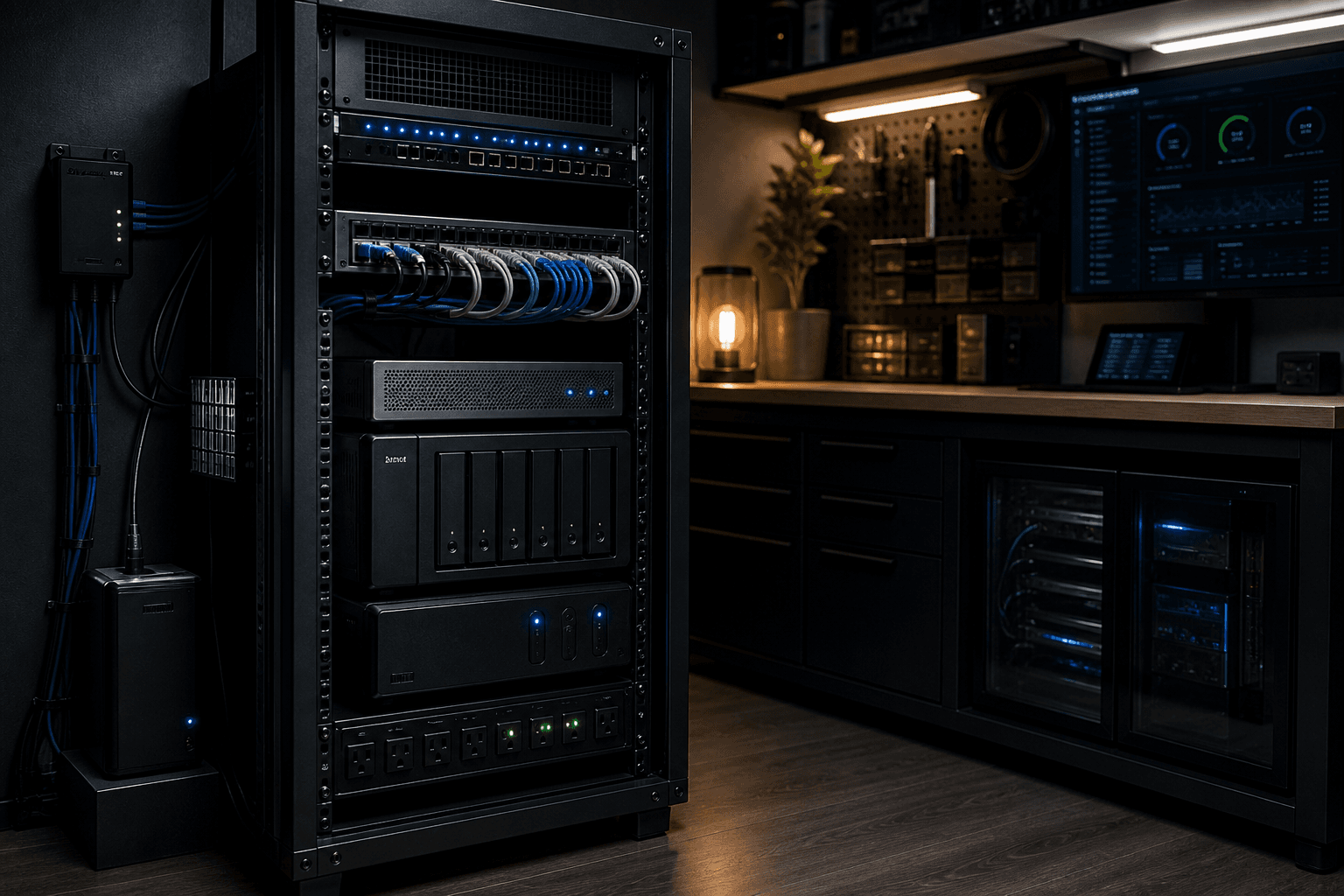
Compact home lab server rack with network switches, storage, power, and labeled cabling

Case Studies

HomeLab Infrastructure

Private HomeLab Infrastructure

यह case study Private HomeLab Infrastructure को real implementation की तरह explain करती है: design choices, integration, reliability, monitoring और operating lessons के साथ।

इस implementation में Every serious smart living system eventually needs infrastructure. Consumer automation can start with apps, hubs, and cloud accounts, but it cannot scale into a reliable, private, intelligent living environment without a proper control plane.

इस implementation में My homelab setups act as that control plane.

इस implementation में Across these implementations, the homelab layer supports Home Assistant, dashboards, local integrations, network segmentation, security camera integration, monitoring, backups, and future automation expansion. The objective is simple: keep the intelligence close to the home, keep the data private, and reduce dependency on fragmented cloud services.

इस implementation में This infrastructure mindset is what separates smart homes from intelligent homes.

इस implementation में The infrastructure is designed with maintainability in mind, so automations, configurations, dashboards, and services can evolve without becoming fragile.

  • Home Assistant acts as the central automation brain, connecting devices, dashboards, sensors, rules, scenes, alerts, और integrations into one coherent system.
  • automation data, device states, camera events, energy trends, और environmental signals are kept local wherever possible to improve privacy, reliability, और control.
  • Network design includes device separation, reliable connectivity, UniFi integration where applicable, camera visibility, और secure access to internal systems.
  • Custom dashboards provide visibility into lighting, climate, energy, water, security, और device state, turning the home into an observable system.
  • Critical systems such as pumps, tanks, power usage, cameras, और environmental controls can be monitored with alerts before small failures become daily disruptions.